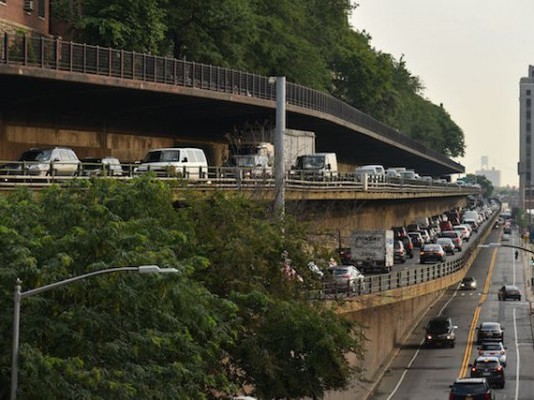
NYC DOT is holding public scoping meetings for the BQE Central Project this week. Below is a guide to what's in DOT's Draft Scope of Work (DSOW), what you can comment on, and questions you may want to ask.
Make your voice heard and demand a thorough evaluation of alternatives that prioritize neighborhood health, public space, and a better future for the BQE.
The BHA will be submitting extensive written comments and we will share those with the community once they have been finalized. Along with other organizations, we have asked for an extension of the public scoping timeline from Nov 23, 2026 to Jan 22, 2027 but are waiting on an answer from the city & DOT.
HOW TO PARTICIPATE
TONIGHT: Tuesday, Nov. 10, 6:30–8:30 p.m. In person at the Auditorium at City Tech, 285 Jay Street.
OR
Thursday, Nov. 12, 6:30–8:30 p.m. on Zoom. You must register in advance: bit.ly/bqecentral-nov12.
WHAT IS SCOPING, AND WHY DOES IT MATTER?
The Draft Scope is DOT's plan for its Environmental Impact Statement (EIS). It says which impacts DOT will study, how large an area it will look at, and what methods it will use. If something isn't in the scope, it may never be studied or mitigated.
The most useful comments now don't just say whether you support the project. They tell DOT what to study, where, and how, and they point out what's missing.
WHAT'S IN THE DRAFT SCOPE, AND WHAT YOU CAN ASK?
1. THE PROJECT ITSELF
What DOT proposes: Rehabilitate all 21 bridges and structures in the 1.5-mile BQE Central Section, keeping the triple cantilever's existing alignment and two lanes in each direction. The Columbia Heights overpass would be replaced. Construction would start around 2029 and finish before 2040.
The biggest change for our neighborhood is the construction of two TEMPORARY BYPASS HIGHWAYS to carry traffic during construction/repair:
- Bypass 1, along Furman Street below the Promenade, from Atlantic Avenue to Columbia Heights.
- Bypass 2, from Columbia Heights, potentially over the Brooklyn Bridge approach and through DUMBO.
The bypasses could remain for up to about 10 years.
Questions to consider:
- How tall and how close to homes, Brooklyn Bridge Park and the Promenade will the bypasses be?
- How will the Hicks Street ramps and local access change, and for how long?
- What happens to the land under the bypasses after they come down?
2. ALTERNATIVES
What DOT proposes: The EIS will compare the Proposed Project against a "No Build" baseline. Other alternatives will be defined only after impacts are identified, and may be studied only qualitatively.
Questions to consider:
- Should the EIS study other construction approaches side by side with this proposal, with real data?
- Should DOT study ways to shorten the construction and repair period?
3. TRANSPORTATION
What DOT proposes: A traffic analysis of morning and evening peaks, plus transit, pedestrian, safety (crash data) and parking conditions, with 2040 as the analysis year.
Questions to consider:
- Which local streets and intersections will be studied for diverted traffic, including Hicks, Henry, Cadman Plaza, Old Fulton and Atlantic?
- Will weekend and midday conditions be studied, not just weekday peaks?
- How will construction trucks be routed, and will that be analyzed street by street?
- What happens to pedestrian and bike routes to Brooklyn Bridge Park and DUMBO?
4. CONSTRUCTION NOISE, VIBRATION AND AIR QUALITY
What DOT proposes: Construction noise measured at 14 locations, including late-night periods. Vibration and construction air pollution (particulates, nitrogen dioxide, carbon monoxide) will also be analyzed. The Draft Scope does NOT plan to analyze noise or air quality from bypass traffic once it's running, since the project doesn't add lanes.
Questions to consider:
- Will there be measurement locations on Columbia Heights, Furman Street, Willow Street, Pierrepont Place and near schools and playgrounds?
- Shouldn't the EIS study noise and air quality from highway traffic moved closer to homes, schools, and parks on the bypasses?
- How will vibration effects on our historic buildings be monitored and prevented?
5. PARKS AND OPEN SPACE
What DOT proposes: Study direct effects (use, noise, air, shadows) on about 18 nearby open spaces, including the Promenade and Brooklyn Bridge Park. DOT has said Harry Chapin Playground would be removed during construction and rebuilt, and Squibb Park and Hillside Dog Park would be affected. Small pieces of parkland would require state "alienation" legislation.
Questions to consider:
- What replacement playground and dog park space will be provided during construction, and where?
- How long will each park be closed or affected?
- How and to what extent will access to Brooklyn Bridge Park, the Promenade, and other open spaces be maintained?
6. HISTORIC RESOURCES, URBAN DESIGN AND VIEWS
What DOT proposes: Study effects on historic resources, including the Brooklyn Heights Historic District and the Promenade, in consultation with the Landmarks Preservation Commission and the State Historic Preservation Office. Views will be assessed with photos and 3D renderings.
Questions to consider:
- Will the EIS show renderings of the bypasses from the Promenade, Brooklyn Bridge Park and our streets?
- Will the protected Promenade views be preserved during and after construction?
7. NEIGHBORHOOD CHARACTER, SHADOWS AND COMMUNITY LIFE
What DOT proposes: Preliminary assessments of neighborhood character and shadows, with detailed study only if certain thresholds are triggered.
Questions to consider:
- Should a decade of construction alongside our homes trigger a detailed neighborhood character analysis?
- Will shadows from the bypass structures on Furman Street, Brooklyn Bridge Park and nearby homes be studied?
8. CUMULATIVE EFFECTS
What DOT proposes: Consider construction effects together with other nearby projects, including the Brooklyn Marine Terminal redevelopment.
Questions to consider:
- What other projects will be included, and will their combined traffic, noise and air effects be studied?
9. MITIGATION
The EIS must identify ways to avoid, reduce or make up for significant impacts.
Questions to consider:
-What specific measures will DOT commit to, such as noise barriers, work-hour limits, air monitoring, or replacement open space?
- Who will residents contact about problems during construction, and how will commitments be enforced?
TIPS FOR AN EFFECTIVE COMMENT
- Start with your name and your connection to the project ("I live on Columbia Heights," "My kids use Harry Chapin Playground").
- Name the place, the impact, and what you want DOT to study.
- Questions are welcome. DOT must respond to every comment and question in its Final Scope.
- Arrive early tonight to sign up to speak, and keep spoken remarks brief, you'll probably be allowed about 3 min tops.
The full Draft Scope and project materials are at:
https://www.nyc.gov/html/dot/html/infrastructure/bqecentral.shtml
Here is a link to a Scoping Testimony Toolkit from Open Plans
The decisions made now will shape our neighborhood for decades. Please take a few minutes to make sure your concerns are part of the record. Written comments count just as much as spoken ones. If you speak tonight, bring a written copy to hand in too.
In writing by Monday, Nov. 23:
- Email: BQECentral@dot.nyc.gov
- Mail: NYC DOT, Division of Bridges, BQE Central Project Team, Attn: Albert Silvestri, 55 Water Street, 5th Floor, New York, NY 10041 |